Trust Deposit and Reputation
Trust Deposit
A Trust Deposit is a stake within a VPR that grows automatically as participants interact with the ecosystem. Each TrustDeposit is keyed to a Corporation (corporation_id): the deposit is held per-Corporation, not per-account or per-Participant-entry. It reflects the Corporation's activity and contribution across every ecosystem it participates in.
How Trust Deposits Grow
-
onboarding process:
When an onboarding process is executed, the trust deposits of both the applicant and the validator Corporations increase. -
credential issuance & verification:
If the ecosystem has enabled pay-per-issuance and/or pay-per-verification, the trust deposits of all Corporations whoseParticipantentries are involved in the tree grow each time a credential is issued or verified.
Additionally, if applicable, the trust deposits of the involved user agent and wallet user agent are also incremented. -
registry participation:
RegisteringParticipantentries and other trust operations in the VPR increases the trust deposit of the Corporation that executes the transaction.
Conceptual Model
The trust deposit functions like a percentage-based deduction applied to circulating trust fees. These deductions accumulate in individual deposits as a reflection of ongoing participation and service provision.
For example, in the case of verification Fees (as detailed in the Credential Monetization section), a portion of each fee is redistributed to grow the trust deposits of the relevant actors in the verification process.

-
Each time fees are charged, an additional 5% (
trust_deposit_rate) is added and allocated to the trust deposit of the Corporation executing the transaction. This amount is also linked to the specificParticipantentry that authorized the transaction (tracked in the entry'sdepositfield). -
When fees are distributed to other participants (e.g., issuers, grantors, etc.), 5% of the distributed amount is redirected to their trust deposit, while the remaining 95% is liquid and immediately available for use.
-
The percentage allocated to trust deposits (
trust_deposit_rate, default 5%) is a global variable configurable by the VPR governance authority.
Trust Deposit Yield
Trust deposits are not idle stakes — they generate yield. Block execution fees are distributed not only to network validators, but also to trust deposit holders. This is governed by three global variables:
trust_deposit_block_reward_share(default 20%) — the percentage of each block reward that must be distributed to trust deposit holders;trust_deposit_max_yield_rate— the maximum yearly yield, in percent, a trust deposit holder can obtain from block rewards;trust_deposit_share_value— the value of one share of trust deposit, in native denom. EachTrustDepositrecords ashareof the module's total deposit rather than a raw amount; the share value starts at 1 and increases over time as yield is produced, so a Corporation's deposit appreciates automatically.
Yield is one more reason a trust deposit is non-withdrawable: locking value into the system sustains token demand and prevents exit-and-rejoin arbitrage on an appreciated deposit.
Core Purposes
The trust deposit mechanism is designed to ensure that participants within an ecosystem adhere to the rules defined in its ecosystem governance framework (EGF). It serves as both an incentive and an enforcement tool within decentralized trust infrastructures.
| Purpose | Description |
|---|---|
| Incentivize Good Behavior | Participants risk losing part of their deposit if they behave dishonestly or violate governance rules. |
| Signal Serious Intent | Requires participants to have "skin in the game," discouraging spam, fraud, and low-effort engagement. |
| Dispute Resolution | Deposits can be partially or fully frozen if a participant has been suspected of misconduct. During the hold period, the ecosystem evaluates whether the participant’s actions caused actual harm. If harm is confirmed, the held deposit may be used—partially or fully—to compensate for the damage. If no harm is found, the deposit is released back to the participant. |
| Enable Slashing | Deposits can be partially or fully slashed when participants breach trust policies or contractual roles. |
| Support Decentralized Governance | Serves as the economic foundation for decentralized participant management, assignment, and revocation. |
| Ecosystem-Specific Control | Each ecosystem can only slash the portion of a participant’s deposit that corresponds to activity within that ecosystem. |
| Non-Custodial | Trust Deposits are held on-chain within a VPR and are not under the control of any centralized authority. |
Slash
Slashing operates at two independent levels:
- network-level penalties — if a participant violates the VPR governance framework or engages in fraudulent activity, their trust deposit may be partially or fully slashed by the VPR's governance authority.
- ecosystem-level penalties — if a participant operates within an ecosystem (as a grantor, issuer, verifier, or holder) and fails to comply with that ecosystem's governance framework (EGF), their ecosystem-specific trust deposit can be slashed by the corresponding ecosystem governance authority. Each ecosystem can only slash the portion of a Corporation's deposit that corresponds to activity within that ecosystem.
Each ecosystem defines, in its ecosystem governance framework (EGF), the rules that participants must follow to remain in good standing, and the conditions under which a slash may occur.
Before executing an ecosystem-level slash, the ecosystem must:
- Assess Harm: Determine whether the participant’s actions caused measurable harm to the ecosystem or its members.
- Compensation Request: Provide the participant with the opportunity to compensate affected parties directly.
- Unresolved Dispute: If the dispute cannot be resolved and harm is evidenced, the ecosystem may authorize a slash.
When a participant is slashed:
- The corresponding portion of their trust deposit is forfeited, based on the severity or type of violation.
- Their ability to perform actions within the ecosystem (e.g., issuing or verifying credentials) is suspended.
- To regain active status, the participant must replenish the slashed amount of their trust deposit.
This mechanism ensures accountability and alignment with the ecosystem’s trust and governance policies.
Trust Deposit-Based Reputation
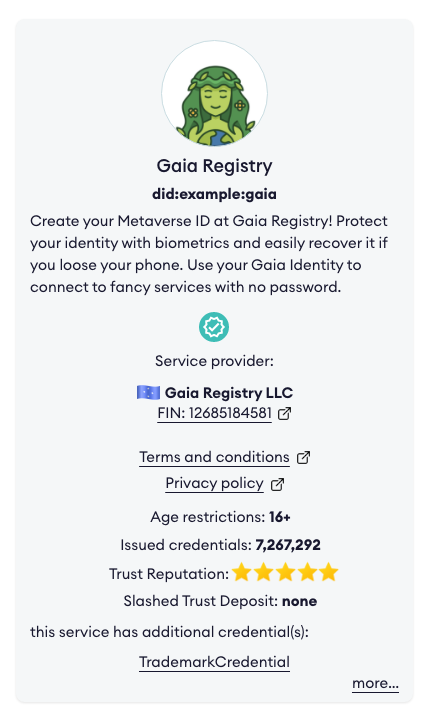
Because network activity and trust deposit data are publicly accessible, each participant naturally builds a digital trust reputation over time. This reputation reflects both their positive contributions and any violations within the ecosystems they engage in.
Key reputation signals include:
- Growth of trust deposit: Active, rule-abiding participants see their trust deposit increase as they contribute value to the network.
- Ecosystem - specific history: For each ecosystem a participant is involved in, their trust deposit history is transparently visible to all other participants.
- Credential activity: The number of credentials issued and/or verified by the participant within each ecosystem is publicly observable.
- Behavioral accountability: Any dishonest or malicious activity — especially if penalized through slashing — remains permanently associated with the participant’s account.
This transparent data can be used to compute a reputation score or star rating, enabling trust-based decisions across the network.